
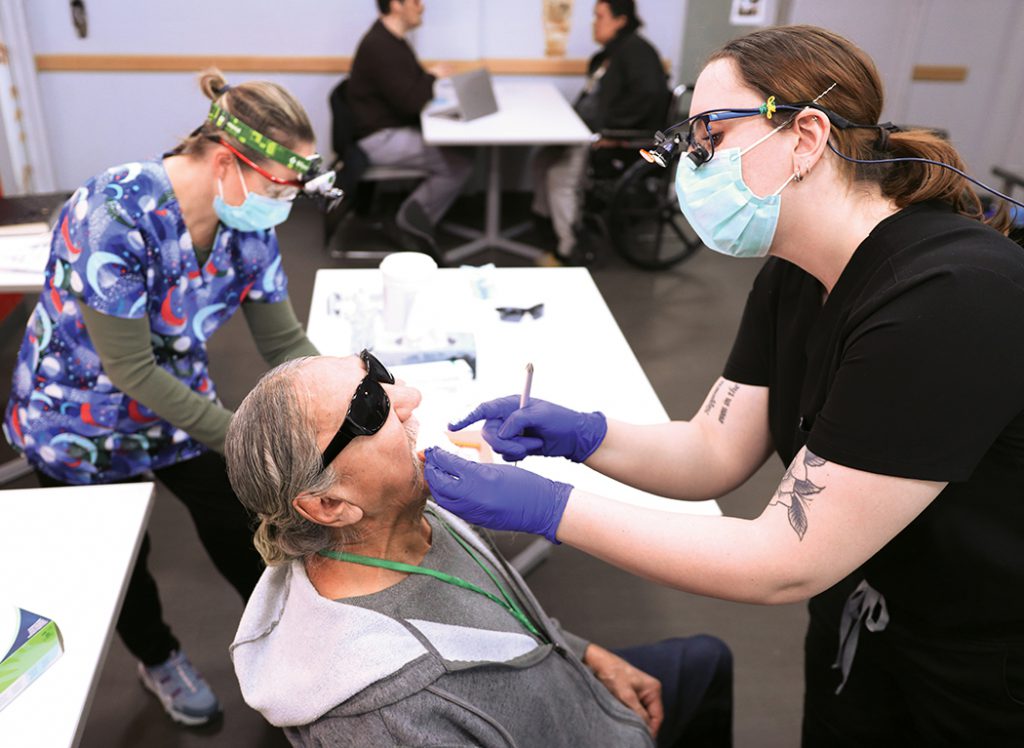
It’s a winter morning on Winnipeg’s gritty Main Street strip.
Inside the Bell Hotel, a housing site for people who have experienced homelessness, an Indigenous resident named Wayne, 68, has a screening appointment with dental hygienists Lezah Evan and Stacey Urban [Dip.D.Hyg./24].
Evan and Urban are the UM oral health community liaisons whose work is currently made possible by financial support from Health Canada’s Oral Health Access Fund (see more).
They’ll assess Wayne’s oral health and refer him for no-cost care at the Dr. Gerald Niznick College of Dentistry’s general clinic, or another community clinic if it’s a better fit.
Since he doesn’t have a phone, a UM dental or dental hygiene student who is assigned his file will communicate with a Bell Hotel worker about his appointments and transportation.
Wayne says he appreciates the hygienists coming to his home building. “It’s awesome,” he says. “I can understand what they’re talking about with my condition and my health.”
Evan and Urban say their community work is tremendously rewarding.
“Pretty much every patient we screen is so thankful,” Evan says. “They’re excited that they’re being seen, not just as a potential dental client, but as a person.”
“This program is a really good way to make care more accessible for those whoare struggling,” says Urban.
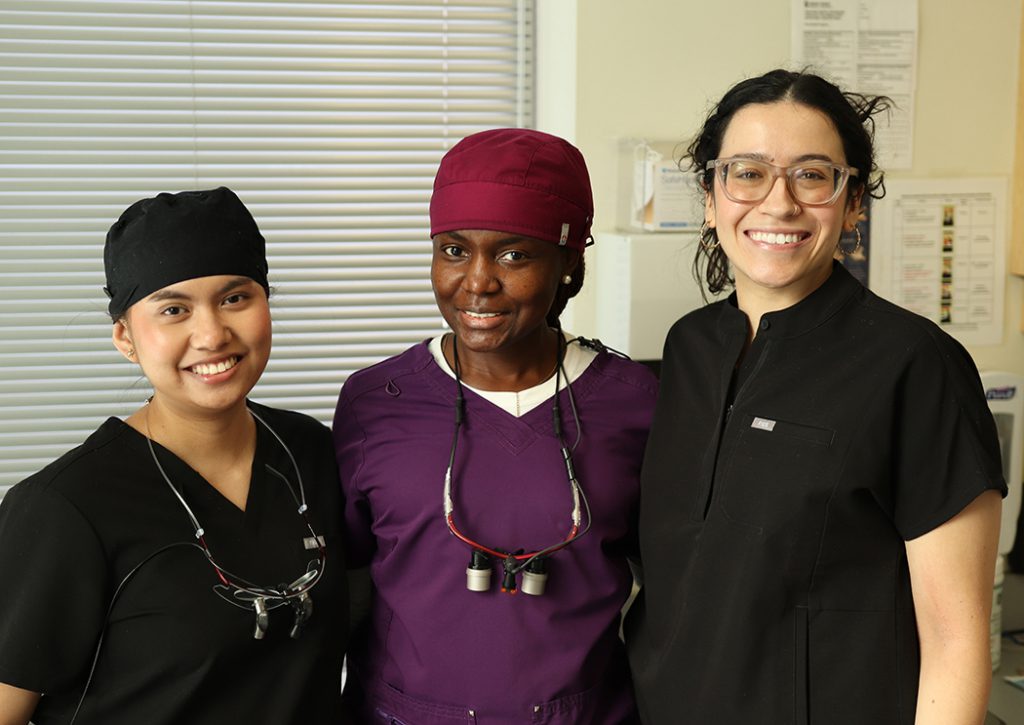
The recent UM graduates working under OHAF funding as apprentices with UM’s Centre for Community Oral Health (CCOH) also feel they’re making a difference.
Mary-Jane Adeloye [DMD/25], who was a dentist in Nigeria before graduating from UM’s International Dentist Degree Program, says she undertook the apprenticeship as a way to give back to the community.
She says many patients at sites like Access Downtown face a host of challenges.
“When they see someone who believes in them, who can look into their eyes and talk to them, it gives them a ray of hope,” she says.
Dental hygienist Lexy Müller Morán [Dip.D.Hyg./25] says part of what inspired her to do community work is knowing the obstacles her parents faced, and the help they received, as immigrants from El Salvador.
At the community sites, she says, “We’re learning the different ways to approach situations. For example, if you have a patient with dementia, maybe the first appointment is just talking. Then we might introduce cleaning one-quarter of the mouth. You meet them where they’re at.”
Hygienist Ashleen Delas Alas [Dip.D. Hyg./25] immigrated to Canada from the Philippines as a child and was raised to “share her blessings” with the community, she says.
Early in their apprenticeship, Delas Alas recalls, she and Müller Morán were assigned to care for a man at Deer Lodge Centre who was 101 years old and in a wheelchair.
“I was worried and thinking, ‘I’m probably not providing the best care, adapting to this new situation,’” Delas Alas says. “But the patient was very understanding.
“We saw him again a month later. He had had a dental exam, and he had been looking for us. He was a wonderful patient, and it made me feel like I had made an impact.”
BY ALISON MAYES