
What if controlling the energy production in our cells could help fight disease?
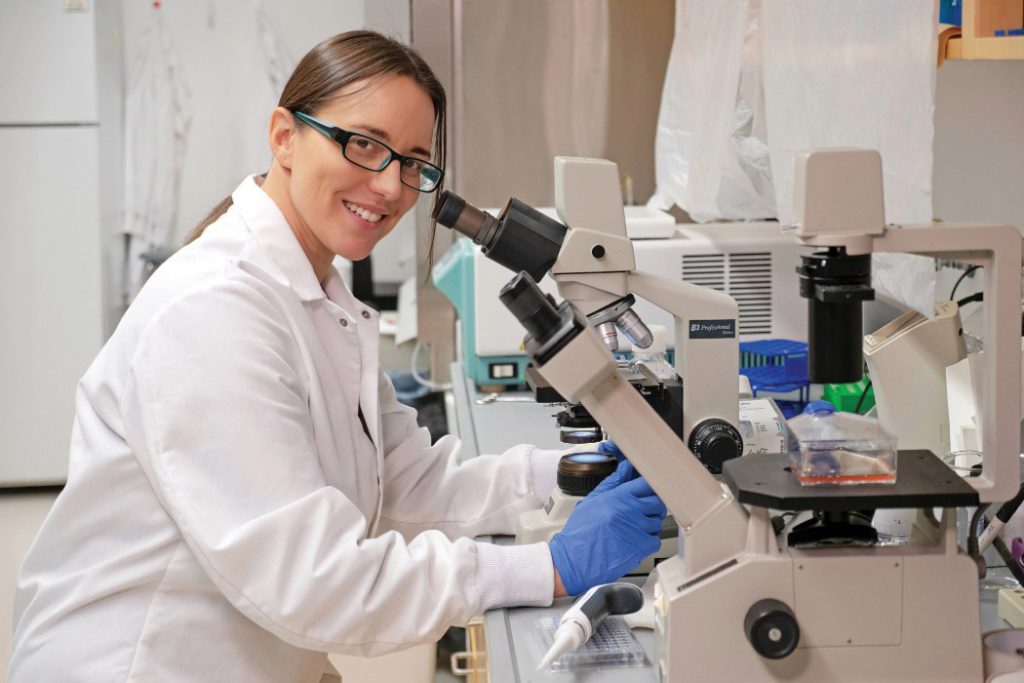
That’s what Samantha Pauls [B.Sc.(Hons.)/09, PhD/17], assistant professor in the College of Pharmacy, has set out to answer.
When we consume too much sugar and fat, Pauls says, stressed fat tissue summons immune cells such as monocytes and macrophages – cells that normally fight infection – as if there’s a germ to attack.
If the stress persists, she says, these cells stay activated and release inflammatory molecules – chemical signals that harm organs like the pancreas and heart, contributing to chronic diseases.
Pauls, an immunologist and biomedical scientist, works in the rapidly evolving field of immunometabolism, studying the interaction between the immune system and metabolism. She is also a researcher with the Children’s Hospital Research Institute of Manitoba.
“I specialize in immune cells,” she says. “I examine chronic inflammation, which is linked to diseases like cardiovascular disease, Type 2 diabetes and what’s commonly known as non-alcoholic fatty liver disease.”
Inside cells, tiny power plants called mitochondria make energy, mostly from nutrients. Pauls says in immune cells, this process doesn’t just provide power; it also sends signals that influence whether cells “switch on” to fight or “stand down” to rest.
“We’re discovering how these pathways can be adjusted, with the goal of preventing harmful overactivation of the immune system and treating chronic inflammation.”
Pauls’ lab studies human cells and mouse models to understand immune cell activation. Her team explores how drugs and dietary components like fatty acids might restore a healthy balance of inflammatory molecules.
She suspects that too much energy production inside cells may trigger activation of monocytes – immune cells that act as first responders to stress or infection.
“In studies published in 2021 and 2025, we looked at the effects of omega-3 fatty acids, which are found in fish oils and are also abundant in flaxseed, chia seeds and canola oil,” Pauls says.
“We found that these anti-inflammatory ‘good fats’ act on monocytes to lower the rate at which they break down sugar and fat for energy. This effect hasn’t been seen before and may be a key way that omega-3s reduce inflammation.”
Pauls hopes her discoveries will lead to strategies – whether dietary, pharmaceutical or lifestyle – to mitigate inflammation and prevent disease. “We’re aiming to develop new tools to calm an immune system gone rogue,” she says.
Pauls’ research has been published in journals such as The Journal of Nutritional Biochemistry, The Journal of Immunology and Arteriosclerosis, Thrombosis, and Vascular Biology.
The scientist, who was raised just outside Winnipeg in St. Clements, Man., earned her bachelor’s degree in biochemistry and her PhD in biochemistry and medical genetics at UM. She completed postdoctoral research at the St. Boniface Hospital Albrechtsen Research Centre before joining the UM faculty in 2021.
An important part of her current role is serving as Rady Faculty programming lead for graduate student professional development, helping graduate students prepare for career transitions.
As for educating new scientists, she finds it inspiring.
“There’s something magical about coming to a deeper understanding of our biology and then instilling that in the next generation – igniting their creativity and curiosity to find solutions.”
BY DANICA HIDALGO CHEREWYK