
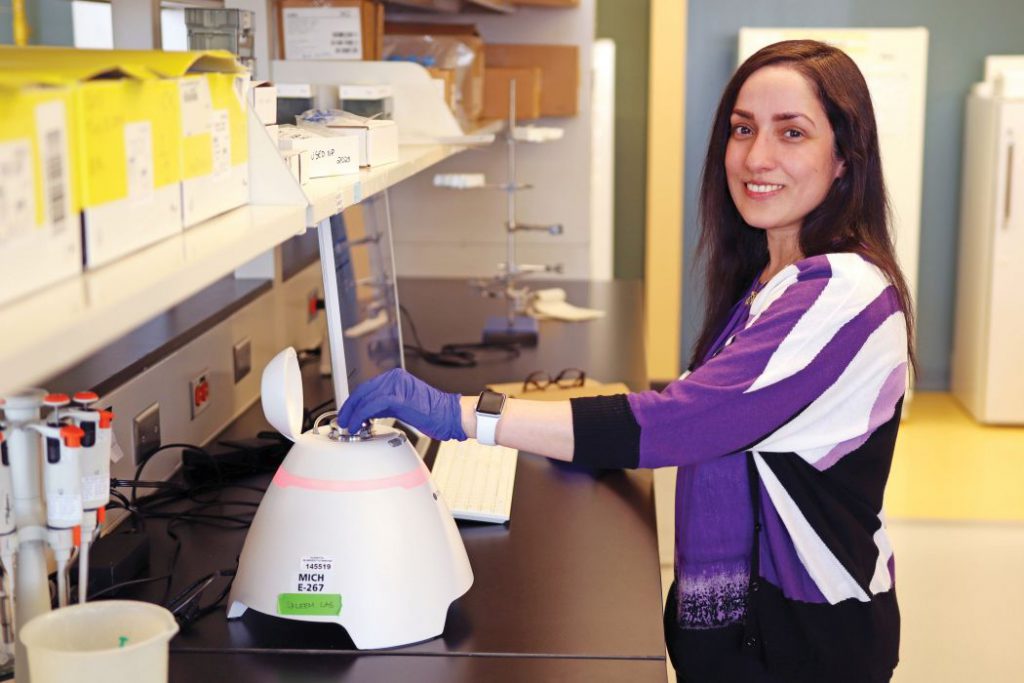
Dr. Ayesha Saleem says there’s no drug on Earth that is as beneficial as exercise.
But one day, you may be able to take a pill that delivers some of the benefits of working out.
Saleem, an associate professor of oral biology, joined the Dr. Gerald Niznick College of Dentistry in 2025. She spent the previous seven years with UM’s Faculty of Kinesiology and Recreation Management, based on the Fort Garry campus.
As a researcher with the Children’s Hospital Research Institute of Manitoba, she has always had her lab on the Bannatyne campus. She now has all her work consolidated on Bannatyne.
Born in Pakistan, Saleem immigrated to Toronto with her family when she was in Grade 9. She earned her bachelor’s, master’s and PhD in kinesiology and health science at York University.
RadyUM sat down with Saleem to learn about her cutting-edge research.
Kinesiology is the study of movement. How did that lead you to lab science at the level of nanoparticles?
Movement is intrinsically linked to health. The fact that our bodies are optimized to move, to walk, to break a sweat, means that movement is an extremely important part of our function.
I wanted to investigate the mechanisms that make it possible for exercise to do everything from slowing the aging process to treating – or even preventing – chronic illnesses.
What are extracellular vesicles, or EVs?
EVs are nanoparticles that are released from all living cells and contain biological material. It doesn’t matter if you’re a potato, a human being or a bacterium, you will release EVs.
Cells send EVs to communicate and tell other cells what’s happening. My lab is the only one in Manitoba studying EVs derived from skeletal muscle.
Why are you so interested in these particles?
There is evidence that exercise can treat many chronic diseases, including heart disease, depression and certain cancers. I’m trying to understand the role of EVs in producing these benefits.
We know that exercise produces mitochondria – tiny structures inside cells that generate energy and are crucial in building healthy cells.
In a 2025 study published in the Journal of Extracellular Vesicles, we were the first to show, using mouse cells, that when we took EVs from muscle cells that had been “exercised” in a petri dish and put them into a dish of regular muscle cells, it increased the mitochondria in the regular cells. It was as if they had exercised, but they hadn’t.
We think this could one day lead to a medication that would provide some of the benefits of exercise. It could help people with mitochondrial disease or those who can’t exercise.
What effect did EVs have on cancer cells in your lab?
In our 2025 study published in the European Journal of Applied Physiology, we took human exercise-produced EVs and put them on human colon cancer cells. The EVs killed the cancerous cells. This is exciting, and the next step is to understand why and how this happened.
I’m looking forward to collaborating with my new dental college colleagues to see what impact EVs have on oral cancer. I’m also planning to study how exercise EVs influence oral health. No one has studied that before.
BY MATTHEW KRUCHAK