
Behind every public health or health education decision, there’s data.
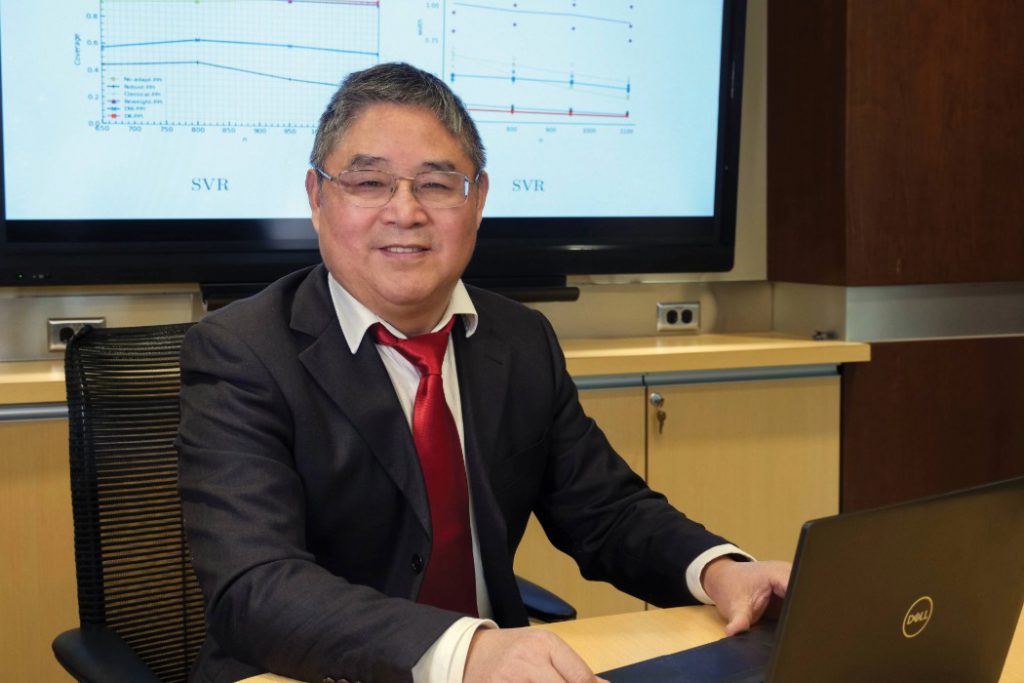
Dr. Depeng Jiang, a professor in the College of Community and Global Health, translates complex data into insights that shape health policy and program design.
As a biostatistician and translational statistician, he works at the intersection of statistics and health sciences.
“I build and test sophisticated statistical tools to evaluate service programs and health policy,” he says. “My team and I find the story in the numbers: who benefits, who doesn’t and why.”
Jiang, a faculty member since 2010, specializes in advanced methods for analyzing longitudinal and multilevel data. He also creates tools that track change over time in diverse populations.
One program evaluation he led in Manitoba assessed the impact of the PAX Good Behavior Game, a school-based prog-ram that promotes children’s mental health.
“Our analysis in 2015 showed how PAX improved mental health and where gaps remained, helping to expand the program to more than 300 schools,” he says.
At UM’s Manitoba Centre for Health Policy, which houses the Manitoba Population Research Data Repository, Jiang develops innovative models for linking together diverse data sources.
When scientists link different kinds of anonymized data, such as social service, justice system, hospital, prescription, medical and educational records, they can reveal connections between different kinds of life experiences.
This cross-sector research, Jiang says, can document the long-term, direct and indirect effects of a health service program. It can also reveal disparities according to gender, socio-economic status or other characteristics.
Jiang’s team was one of the first in Canada to use a statistical framework called “multilevel joint modelling” to link social service, education and health data to show how involvement with Child and Family Services relates to children’s school outcomes and mental health.
Jiang leads the biostatistics group at the George & Fay Yee Centre for Healthcare Innovation, a unit jointly operated by UM and Shared Health. There, his team facilitates the management, analysis and linkage of data for patient-oriented research.
He is also affiliated with the Children’s Hospital Research Institute of Manitoba and the Centre on Aging at UM.
He has 113 peer-reviewed publications to his credit, in journals such as Statistics in Medicine, Statistica Sinica and Prevention Science.
Jiang’s path began in rural Jiangsu Province, China. After earning degrees in mathematics and applied statistics, he worked as a statistician for the Chinese government before pursuing postdoctoral research in economics at Johns Hopkins University, in quantitative psychology at York University and in management science at Nanjing University.
“My motivation comes from wanting to address real-world health and education questions,” he says. “Well-designed analyses can inform better programs and policy. Training the next generation of statisticians and building collaborative networks are core to my work.”
Jiang was drawn to UM, he says, by the opportunity to build a rigorous biostatistics program within a strong health sciences environment.
He attributes his success to the support of his colleagues, department leaders and mentors, such as Robert Tate [M.Sc./75, PhD/00] and Lisa Lix [M.Sc./91, PhD/95].
“Respect for the work I do with numbers means a lot,” he says. “It’s rewarding to know peers value my expertise and are eager to collaborate.”
BY DANICA HIDALGO CHEREWYK