
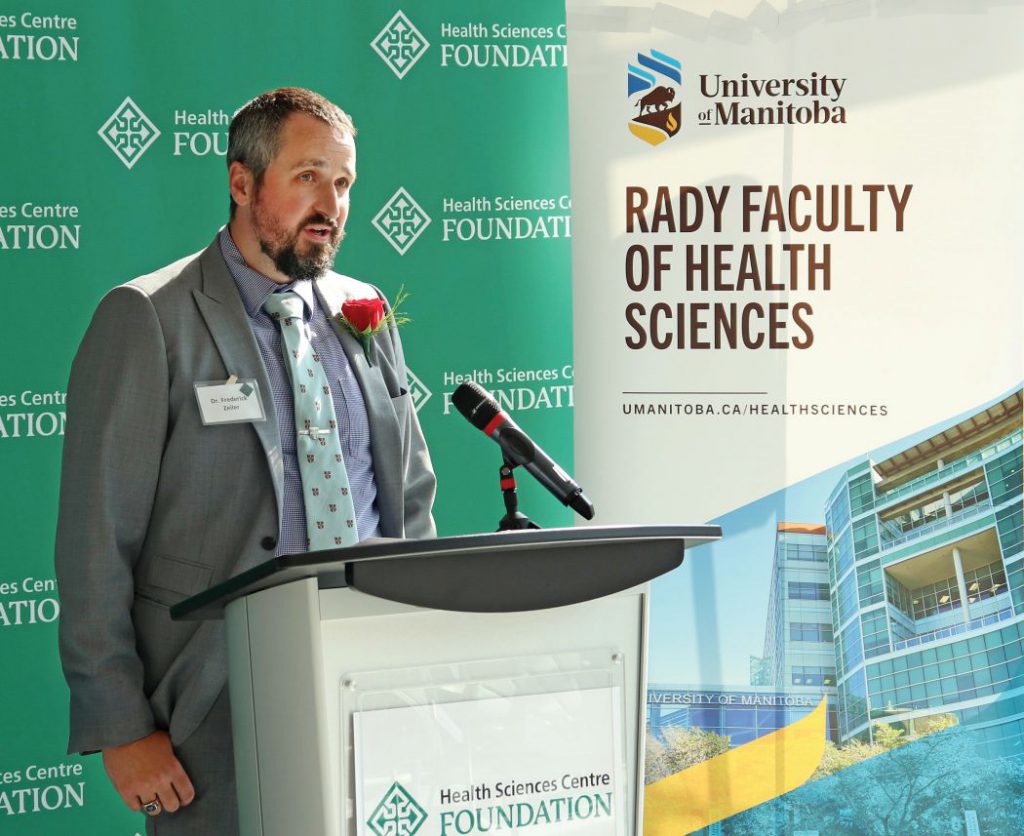
During his early training in neurosurgery, Frederick Zeiler [B.Sc./05, MD/10] observed that there was a lot of information about head-injury patients available to physicians that wasn’t being used or analyzed.
Monitors and devices at the bedside were capturing data. But no one was trying to understand the condition of individual patients, Zeiler says. People with head injuries were all being treated in the same way.
“That’s what really motivated me to think outside the box, leverage all this information, and improve and personalize care,” says Zeiler, a UM medicine grad who is a professor of surgery in the Max Rady College of Medicine.
Zeiler’s curiosity and determination to make sense of the data led him to England to pursue his PhD at the University of Cambridge. There, he learned from the world’s top scientists who were blending neuroscience with biomedical engineering.
Zeiler, whose hometown is Beausejour, Man., joined UM as a faculty member in 2016. He is now a leading international expert in using elements of basic neuroscience, engineering and computer science to better understand the brain.
He is cross-appointed in UM’s Price Faculty of Engineering and is an affiliate researcher at both the Karolinska Institute in Sweden and the University of Cambridge.
In 2022, the Health Sciences Centre Foundation, Manitoba Public Insurance (MPI) and UM jointly announced $3.5 million in support for research led by Zeiler, naming him the university’s inaugural MPI Chair in Neuroscience.
“The funding has allowed me to expand my lab, attract talent and buy cutting-edge equipment,” he says. “It has raised the stature of my research program, making us competitive for federal funding opportunities.”
Zeiler’s current focus is on understanding the connections between blood flow, oxygen and nutrient delivery to the brain and developing non-invasive monitoring devices.
Much of his work involves processing data from about 150 Manitobans per year who have suffered catastrophic brain injuries. His lab is the only one in North America that collects advanced physiological data of this kind.
“We’re combining this data with advanced mathematical modelling to better understand individual differences,” says the professor.
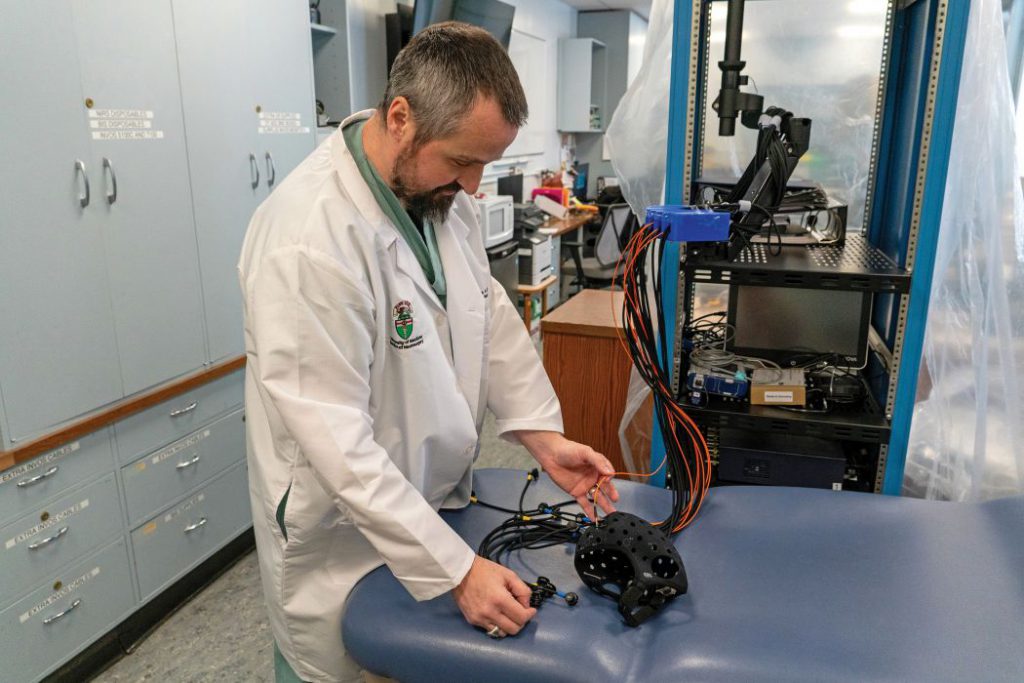
Traditionally, Zeiler says, MRI or CT scans would be used to reveal blood flow in patients’ brains. But those machines are expensive, are located only in certain hospitals, and produce scans that are only a snapshot in time.
Determined to do better, Zeiler has invented a portable device in the form of a cap with sensors and wires that is worn by the patient. It continuously measures brain blood flow in real time.
“We’ve done some feasibility testing, and it’s showing good results when used on healthy volunteers,” he says.
Zeiler has provisional patents filed for this device through UM. The first description of the technology was published in Frontiers of Physiology.
Pressure changes in the brain also vary among patients after traumatic head injury, and this has been difficult to capture, the scientist says.
He and his team have developed algorithms to detect individual features of these pressure changes and provide real-time updates to physicians.
He recently published in the journals Critical Care and Bioengineering some of the world’s first personalized monitoring results for pressure inside the brains of people who have suffered head injuries, with provisional patents filed on this innovation.
Zeiler says that when a patient has a severe head injury, part of the treatment in the acute phase is to give lots of sedative drugs to quiet the brain, in hopes that once the inflammation settles down, the brain
will heal.
When Zeiler and his team looked at the electrical activity of the brain while sedative drugs were being given, they were the first in the world to discover that patients who were under-sedated or over-sedated had an increased risk of poor blood flow and stroke.
“We found there was a sweet spot for sedation that varied between patients, and in any given patient over time,” he says.
“We have provisional patents filed on a process that would provide live updates at the bedside, so the physician could find the sweet spot to avoid unwanted brain injury from over- or under-sedation.”
The results were published in Intensive Care Medicine Experimental and Critical Care Medicine Explorations.
Zeiler’s lab is now well established, but it wasn’t always that way. After his PhD, he had offers to join labs at other universities, but he wanted to open his own lab from scratch. He had the opportunity to do that at UM.
“Part of the challenge in returning to Canada was that my particular field of research is so niche that there weren’t a lot of people who were well-versed in it when I had questions.
“But I found great support from the leadership at the Rady Faculty, UM’s medical college and the surgery department, who provided excellent advice and mentorship. I couldn’t have asked for more.”
Contributing to scientific and medical progress is what drives Zeiler.
“I think that’s all that really matters. If someone, when I’m no longer here, can use something that I’ve discovered or written about and it leads to the next advancement, you know, that’s all that matters.”
BY MATTHEW KRUCHAK