
The College of Nursing’s Manitoba Centre for Nursing and Health Research (MCNHR) recently marked 40 years as a successful catalyst for nursing-led research.
The unit was founded in 1985 as the Manitoba Nursing Research Institute by the late Dr. Helen Glass [Cert.Nurs.(T&S)/58], director of what was then the School of Nursing.
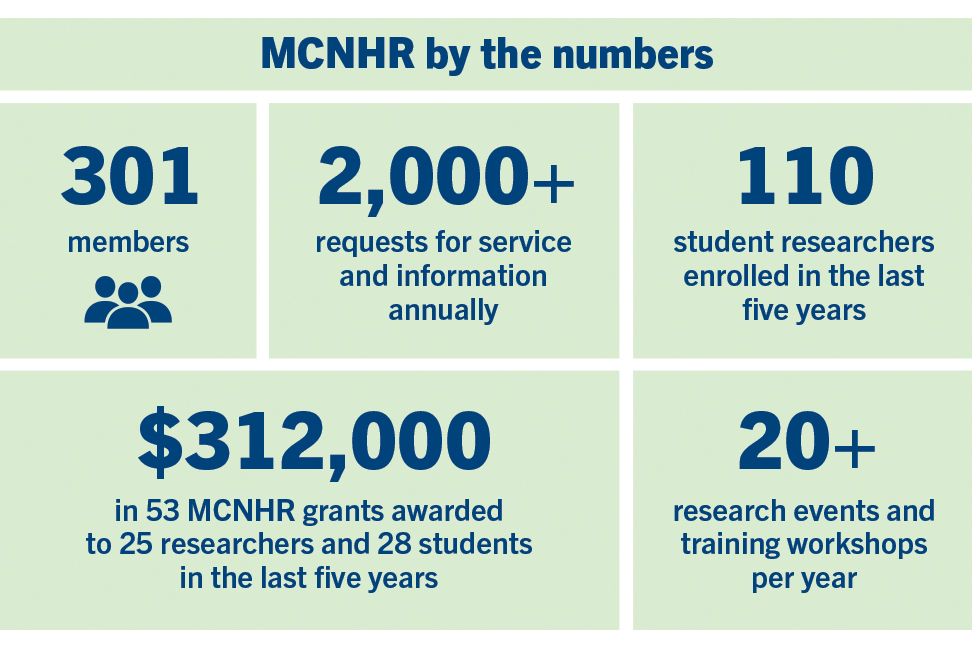
Since it gave out its first $4,000 grant in 1998, the MCNHR has grown to the point of awarding nearly $100,000 per year to faculty and student researchers.
Dr. Lynda Balneaves [B.Sc./90, BN/94, MN/96], associate dean (research) and director of the MCNHR, calls it a rare-in-Canada “one-stop shop” that supports researchers and helps them secure internal and external funding.
Here are just a few of the innovative and impactful studies conducted by MCNHR members over the last four decades.
Women’s perception of pregnancy risk
In 1996, faculty members Maureen Heaman [BN/78, MN/87, PhD/01] and Annette Gupton [MN/82, PhD/94] began research to create a first-of-its-kind questionnaire on women’s perception of pregnancy risk, which was used in a study comparing women with complicated and uncomplicated pregnancies.
The self-administered questionnaire assesses a pregnant woman’s perception of risk for themselves and their unborn baby.
In 2009, Heaman and Gupton published a paper on its reliability and validity in Research in Nursing and Health. The questionnaire is still in international use.
“I’ve had requests to use it from researchers in countries such as the U.S., Brazil, India, Nigeria and Pakistan,” says Heaman, now a professor emerita.
Preventing child maltreatment
In 2010, Christine Ateah [BN/80, PhD/00] from the College of Nursing began working with Dr. Joan Durrant from the department of community health sciences. Durrant was developing a program called Positive Discipline in Everyday Parenting (PDEP), designed to help parents guide their children without using physical or emotional punishment.
PDEP received several grants to evaluate its effectiveness, including funds from the Public Health Agency of Canada and the Social Sciences and Humanities Research Council.
Research revealed that parents who had taken the PDEP program showed significantly less support for punishment, more knowledge of child development and a greater sense of competence as parents.
The program has been delivered in more than 40 countries.
Diversified understanding of First Nations heart health
In 2014, nursing prof Dr. Annette Schultz and Indigenous scholar Dr. Moneca Sinclaire [BHEcol./89, M.Sc./97] launched a project focused on heart health among First Nations people.
The five-year study – funded by the Canadian Institutes of Health Research – represented a pivotal shift toward Indigenous community-led and decolonizing research methods.
Bringing together health-care professionals and Indigenous Elders, Knowledge Keepers and scholars, the study took a “two-eyed seeing” approach, viewing heart health from both a biomedical perspective and an Indigenous worldview.
The study, Debwewin – The Truth of our Hearts, led to a podcast series released by Witness: The Canadian Journal of Critical Nursing Discourse.
Listen to the podcast: https://bit.ly/49TP0gD
Engaging youth as research team members
Roberta Woodgate [BN/89, MN/93, PhD/01], distinguished professor of nursing and Canada Research Chair in child, youth and family engagement in health research and healthcare, works with youth as members of her research teams, often addressing sensitive topics, such as mental health.
Youth voices are welcomed, respected and heard, Woodgate says.
In 2020, she began a study on the perspectives of youth who self-harm. Using arts-based research, her team created a virtual 3D gallery that features paintings, poetry and dance pieces by the young people.
“These youth wanted people to know what it’s like, to show their struggles and how they deal with them,” Woodgate says.
View the gallery: https://www.ingauge.ca/gallery
BY ALAN MACKENZIE