
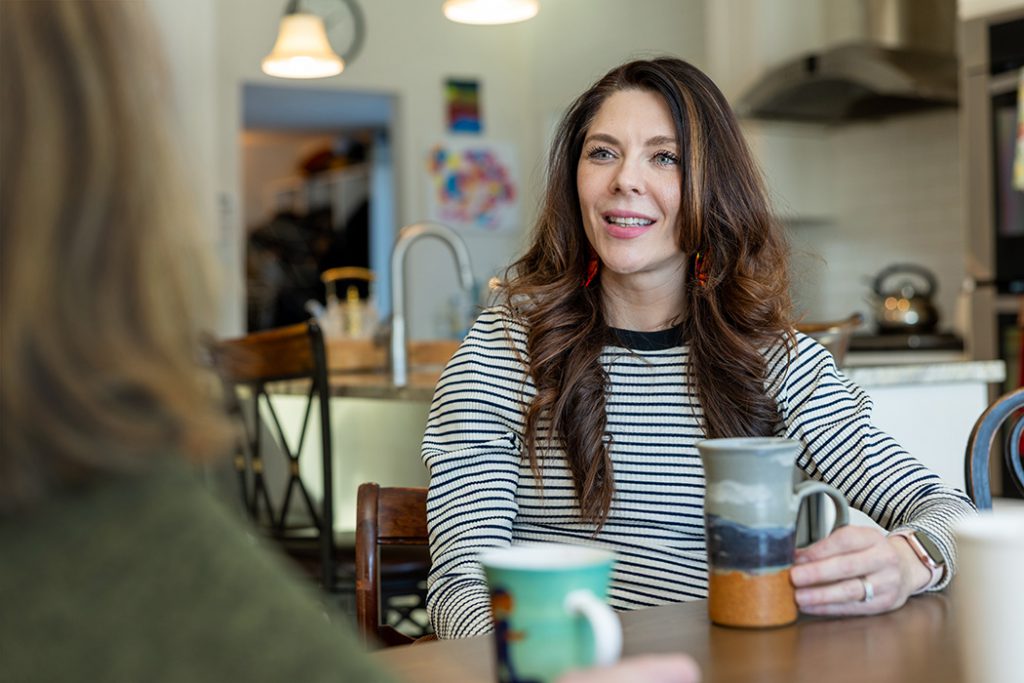
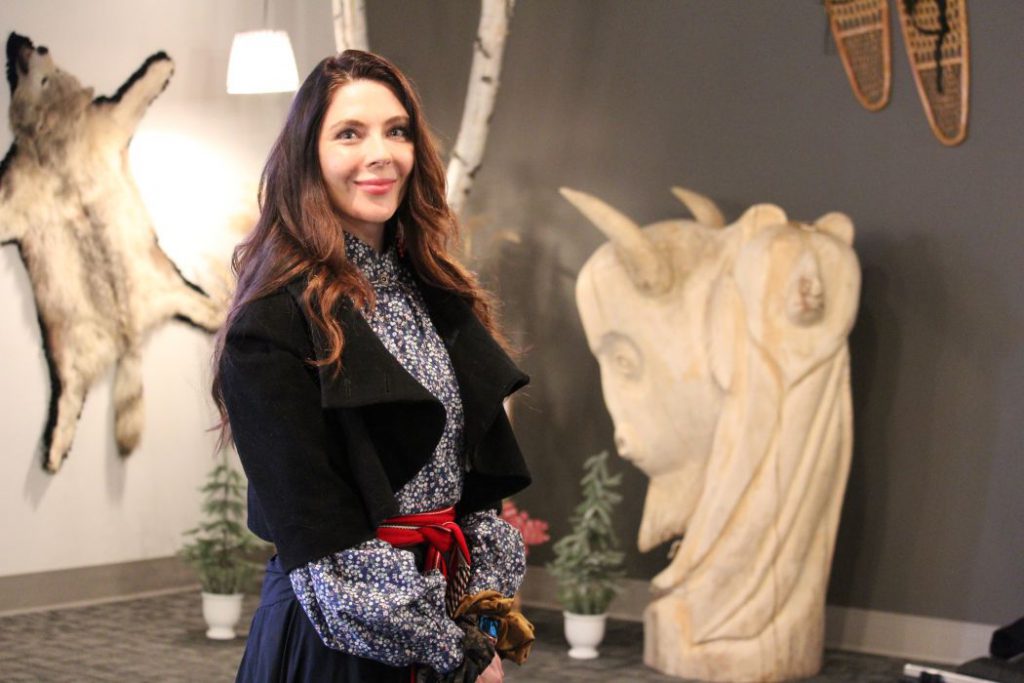
Vanessa Van Bewer [BRS/00, MN/13, PhD/21] has always been surrounded by stories and storytelling.
Growing up in Winnipeg’s close-knit francophone Métis community, she heard relatives, teachers and Elders share tales at family gatherings, school and community events.
By Grade 7, she had discovered her own gift for this kind of communication. “It was a real passion of mine, this idea of telling and listening to stories,” says Van Bewer, who calls herself “a daughter of the Red River.”
The assistant professor of nursing is also a poet and spoken-word artist with an interest in participatory theatre as a teaching tool.
She says she brings a “storytelling sensibility” to both generating and transmitting research findings.
Van Bewer started her career with a degree in recreation studies at UM. She pivoted to nursing a few years later, obtaining a bachelor’s degree from the University of Calgary. She returned to UM for her master’s degree while also working as an instructor at the College of Nursing.
It was then that she was inspired to pursue a PhD. “I started seeing patterns in nursing education – how some students struggle, and why they struggle.”
For her thesis, she used participatory theatre to engage nurses and nursing students in dialogue about the Truth and Reconciliation Commission of Canada’s Calls to Action.
She joined the faculty in 2021, becoming the first self-declared Indigenous professor appointed to the College of Nursing. Her research has been published in journals such as Nurse Education Today, Canadian Journal of Nursing Research and AlterNatives.
In a recent study, Van Bewer focused on identifying disparities experienced by racialized nursing students at UM. The participatory study team included racialized student researchers and an Indigenous Knowledge Keeper.
The team received 280 survey responses from nursing students and held sharing circles with more than 30 students.
“We had a dialogue about disparities that are just not captured in other ways,” Van Bewer says.
The quantitative data about students’ experiences was analyzed using Quant-Crit (quantitative critical race theory). “It’s a critical framework that challenges assumptions typically embedded in quantitative research about who is counted, how, and to what end.”
More than half of the participating students said they had experienced failure at some point in their nursing education.
The study also found that academic failures in nursing school were seven times more common among racialized women than among white men. And most failures occurred in high-stakes skills demonstrations, where a student is one-on-one with an instructor.
“Interestingly, very few failures occur in the clinical context, where the educator is assessing students over weeks or months. That study prompted me to turn my research focus toward leadership.”
Van Bewer is now working on two interconnected projects related to leadership, both using storytelling methods. The first is co-led with Dr. Chelsea Gabel, scientific director of the Institute of Indigenous Peoples’ Health at the Canadian Institutes of Health Research.
The project uses “trickster-inspired” storytelling as a way to encourage academic leaders to reflect. Tricksters are mischievous figures in the folklore of many cultures who are playfully disruptive and ask uncomfortable questions, Van Bewer says.
The study method involves community storytellers having conversations with non-Indigenous academic leaders.
“Through trickster-type questioning, these conversations prompt leaders to reflect on responsibility, experience discomfort and learn from past stumbles.”
Van Bewer’s other current project explores the experiences of Métis women in health-care leadership roles. This research, co-led with Dr. Angie Bruce [MBA/09], vice-president (Indigenous) of UM, aims to generate recommendations to support Métis women’s leadership development and strengthen culturally safe health care.
Van Bewer and Bruce asked eight Métis women health-care leaders from across the Métis homeland to share their stories. A Métis doctoral student hired through UM’s Indigenous Summer Student Internship Program engaged in informal, one-on-one conversations with the leaders.
“Conversations unfolded in kitchen-table- style settings over tea, food, kinship and laughter,” Van Bewer says. “This approach reflects the ways Métis women have always shared knowledge. The kitchen table is a place of trust.”
Van Bewer says the project was partly inspired because Métis men’s stories – like those of Louis Riel and Cuthbert Grant – are well known and retold, while those of Métis women are often forgotten.
Participating leaders described navigating systems that often misunderstand or minimize their Métis identities, while constantly having to advocate for culturally safe health care within mainstream structures.
“What emerged was a leadership practice defined by relationship,” Van Bewer says. “Success was measured through connection to families, communities and colleagues.
“They described a leadership grounded in truth-telling and directness, where honesty itself becomes a form of care.”
The next phase of the project will be a Métis kitchen party that brings together several of the participants with the researchers and a Métis Elder to reflect on the collective leadership story that has emerged.
A video crew will document the gathering so the teachings can be preserved and shared broadly.
“The Métis women in this study, from physicians to midwives to researchers, have carried these teachings into spaces from operating rooms to boardrooms,” Van Bewer says.
“A seat at a Métis kitchen table prepares you for just about any table life sets before you.”
BY ALAN MACKENZIE