
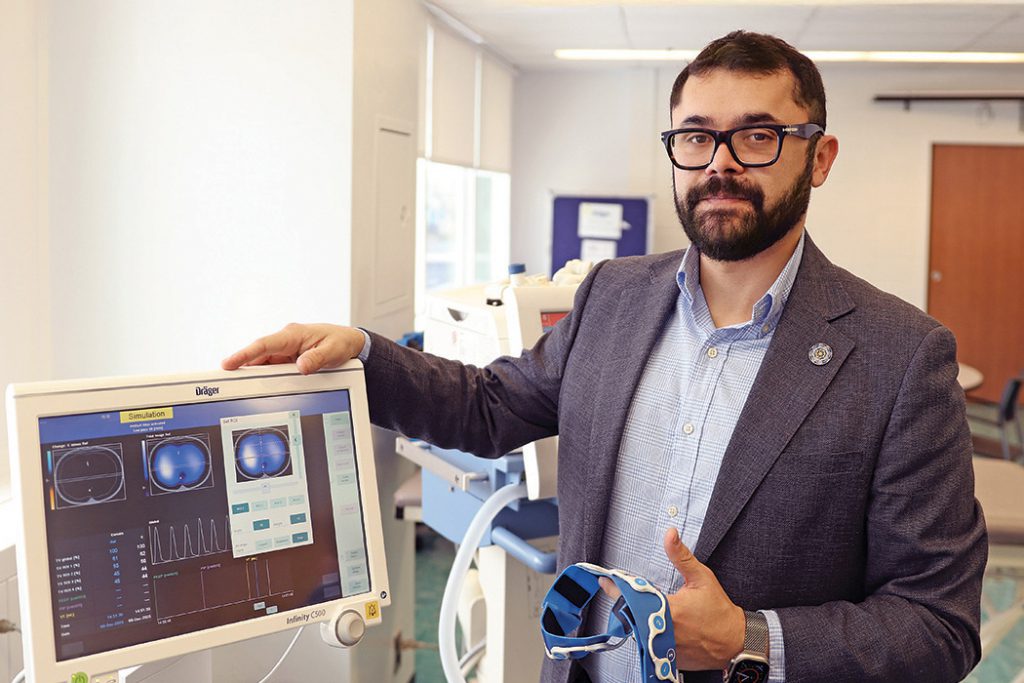
When Dr. Mayson Sousa first saw how mechanical ventilators were used in respiratory care, he immediately wanted to learn more about them.
“I saw that you can really change or improve a patient’s condition by making very small adjustments. But lungs can also be harmed if it’s not properly done. I was fascinated,” says Sousa, an assistant professor of respiratory therapy at UM.
Sousa grew up in a small town in northeastern Brazil and attended the nearby State University of Piaui. While working toward a bachelor’s degree in physical therapy, he took a course in respiratory care, where his interest was piqued.
He then attended the University of Sao Paulo – Brazil’s largest university – where, in 2019, he completed his PhD in pneumology.
His thesis focused on how patients interact with mechanical ventilation, with the goal of improving synchronization between the patient and machine.
“We identified simple measurements that can be taken as soon as the patient is intubated, or put on the ventilator, to help predict which patients are at higher risk of poor interaction with the machine,” he says.
Sousa spent the next few months working in intensive care units during the early days of the COVID-19 pandemic. As the pandemic progressed, he became involved in COVID-19 research, contributing to the country’s national clinical guidelines and helping implement a telemedicine program that provided clinical guidance and training to health-care professionals.
In 2021, he received a scholarship for a postdoctoral fellowship at the University of Toronto to work alongside Dr. Laurent Brochard, a researcher he had long admired.
“He is one of the most prolific and influential researchers in mechanical ventilation worldwide. Much of my PhD research was informed by his work.”
In Toronto, Sousa used animal models and electrical impedance tomography (EIT), a radiation-free, non-invasive bedside imaging technology, to inform more protective approaches to mechanical ventilation.
EIT, he says, looks at two key mechanisms of ventilator-induced lung injury: lung collapse, which reflects insufficient air in parts of the lung, and lung hyperinflation, which reflects excessive air.
“Using a pig model that closely mimics lung injury observed in humans, we found that to reduce injury, preventing lung collapse was more critical than preventing hyperinflation.”
Sousa joined UM’s College of Rehabilitation Sciences in January 2025. He continues to work with EIT, which has not previously been used clinically or in research in Manitoba.
He also recently joined the Children’s Hospital Research Institute of Manitoba and is expanding his work to include pediatrics and neonatology.
Sousa says his ultimate goal is to reduce the risk of ventilator-induced lung injury, and part of that is getting the word out to clinical spaces about the latest advances.
In October 2025, he hosted an online grand rounds event on mechanical ventilation that brought together more than 90 professionals from across Canada. He plans to continue the events every four to six months.
“Any health-care professional interested in mechanical ventilation is welcome to attend,” he says.
“Having this connection with the clinical community is very important for the research, because at the end of the day, the research we are doing is for them to apply.”
BY ALAN MACKENZIE