
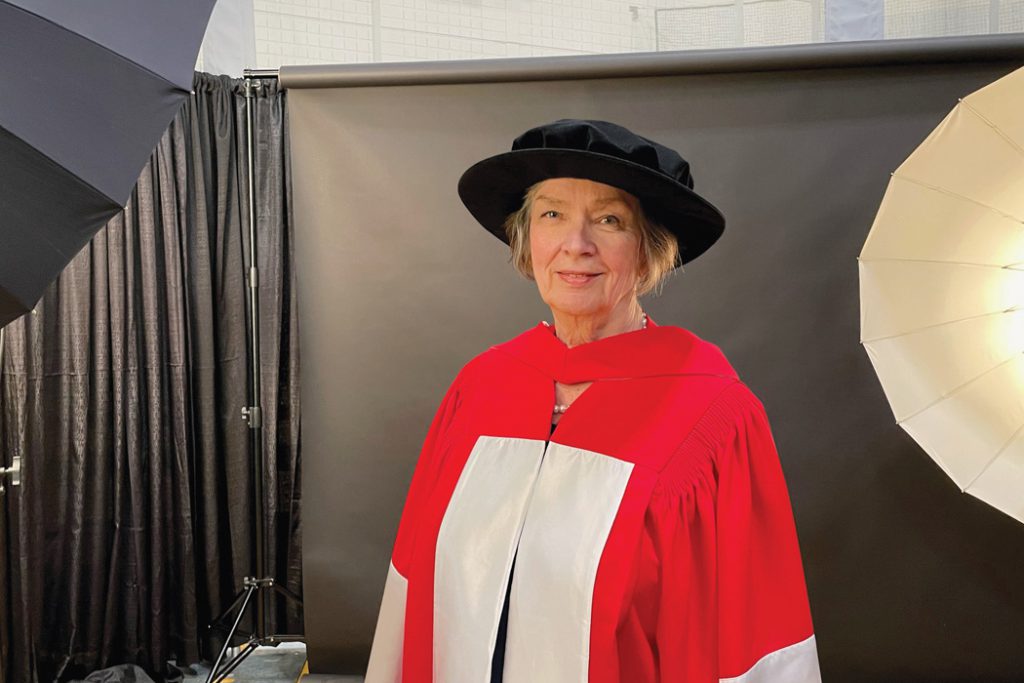
When retired nursing leader Jan Currie [BN/72, LLD/22] heard she’d been nominated for an honorary doctorate at UM in 2022, she was so surprised that she started researching past recipients.
She learned that since the university started awarding honorary degrees in 1911, only four had been given to nurses, the last one in the 1980s.
“When I was on that stage, I felt like I was representing nurses more than my own career,” she says.
When Currie received the degree – 50 years after graduating in 1972 – she was called “a pioneer” by Dr. Netha Dyck [BN/88],then dean of the College of Nursing.
Currie, a product of Winnipeg’s St. James neighbourhood, had wanted to be a nurse since she was six years old. She remembers being inspired by a series of books for girls about Cherry Ames, a mystery-solving nurse.
“She was like Nancy Drew, but did all these interesting things in nursing. She was a travel nurse, an army nurse or an OR nurse. It really made me think about what a woman can do in a career.”
Straight from high school at age 17, Currie entered UM’s four-year bachelor of nursing program, which was still quite new. Most nurses then earned a diploma at a hospital.
While many at the time thought the university program was just about more “book learning,” Currie says there were a lot of practice settings that were not a focus in hospitals, such as community care, home care and public health.
Her first job was at the rehabilitation hospital at what is now Health Sciences Centre. She soon stepped into her first leadership position, as assistant head nurse. In 1974, she moved to the new Concordia Hospital as director of staff development.
Taking leadership roles at new facilities became a theme in her career. She joined Seven Oaks General Hospital in 1980 as director of nursing, and Deer Lodge Centre as nurse manager in 1989.
“I always enjoyed being a part of new things,” she says.
She stayed at Deer Lodge for over a decade and became its CEO, working to establish its dialysis centre and acute care unit.
While in that position, she also obtained her master of health-care administration degree from Central Michigan University, through a distance program on weekends.
In 1999, Currie became the first chief nursing officer and vice-president of the Winnipeg Regional Health Authority (WRHA). There, she led 7,000 nurses and developed a nursing leadership council that brought nursing input into all aspects of the region.
She worked alongside Brian Postl [MD/76], who created the WRHA’s structure of cross-facility and interprofessional care.
This approach promoted equality for every member of the health-care team, Currie says. “There was more respect for nurses than I had seen previously.”
Currie was an assistant professor of nursing at UM from 1995 until her retirement in 2009.
She stayed connected post-retirement through her work as a consultant and on numerous boards, including for the Women’s Health Clinic.
“It’s an amazing honour to be a nurse,” she says about her cherished profession. “You’re there for the most personal parts of people’s lives.”
BY ALAN MACKENZIE