
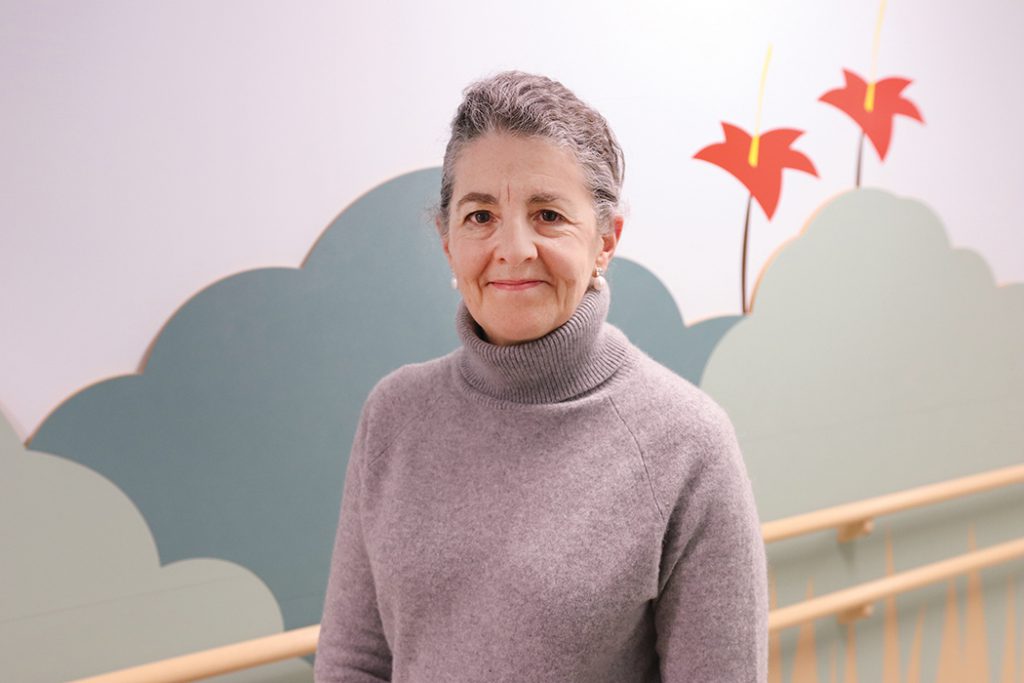
Ana Hanlon-Dearman [BN/84, MD/94, M.SC./03] holds many titles that reflect her expertise in neurodevelopmental disorders.
The professor of pediatrics and child health is chief medical officer at the Rehabilitation Centre for Children and medical director of the child development clinic at Specialized Services for Children and Youth, to name only two of her Manitoba leadership roles.
Distinguished in both clinical care and research, with a particular focus on fetal alcohol spectrum disorder (FASD) and autism spectrum disorder, Hanlon-Dearman took on a new role in 2025.
The three-time UM alum is now associate dean (student affairs) at the Max Rady College of Medicine.
“I understand how conditions like ADHD and learning differences impact learners,” she says. “I understand accessibility and accommodations. I really want to support the success of learners who come to medicine with a variety of backgrounds.”
Hanlon-Dearman, who grew up mainly in Winnipeg, says her own story helps her to appreciate learners’ different paths.
After graduating from UM as a nurse in 1984 and practising for a few years, she recalls, she worked for two years at a nursing station in a remote Inuit hamlet on Baffin Island.
That experience shaped her view of health as entwined with community. And it influenced her to return to UM and become a physician.
People kept telling her that being a nurse would make medical school easier. “But the first two years, doing the courses like biochemistry and histology, was harder than I thought. And my husband and I had our first two babies during those four years,” she says.
“Now, when I hear the stories of medical students who are parents, or didn’t have some of the social or educational advantages, I want them to know: You have people here who believe in you.”
Hanlon-Dearman says she had “tremendous mentors” at UM who believed in her, including Sally Longstaffe [B.Sc.(Med.)/71,MD/71], who inspired her to specialize in developmental pediatrics, and Dr. Michael Moffatt, who encouraged her to augment her MD with a master’s in community health sciences.
“I had never thought of myself as a researcher, but he really encouraged me to ground my clinical thinking in research.”
Hanlon-Dearman, who is also affiliated with the Children’s Hospital Research Institute of Manitoba, went on to collaborate on numerous studies of FASD, including groundbreaking UM projects that used population data to shed light on the disorder’s prevalence and incidence.
She is now part of a UM team that’s working to validate a biomarker of prenatal alcohol exposure. It could lead to a blood test that would confirm whether a person was exposed to alcohol during their mother’s pregnancy.
“It would help with early diagnosis in children,” Hanlon-Dearman says. “For adolescents and adults, it could help to confirm that the difficulties they have experienced, such as with executive functioning, are related to that exposure.”
The pediatrician hopes tomorrow’s doctors are attuned to conditions that aren’t necessarily visible, such as neurodivergence.
“There’s still a huge gap in providing non-stigmatizing, supportive care for adults with developmental disabilities,” she says.
“If we had medical professionals who understood developmental differences at all ages, that would be a dream.”
BY ALISON MAYES