
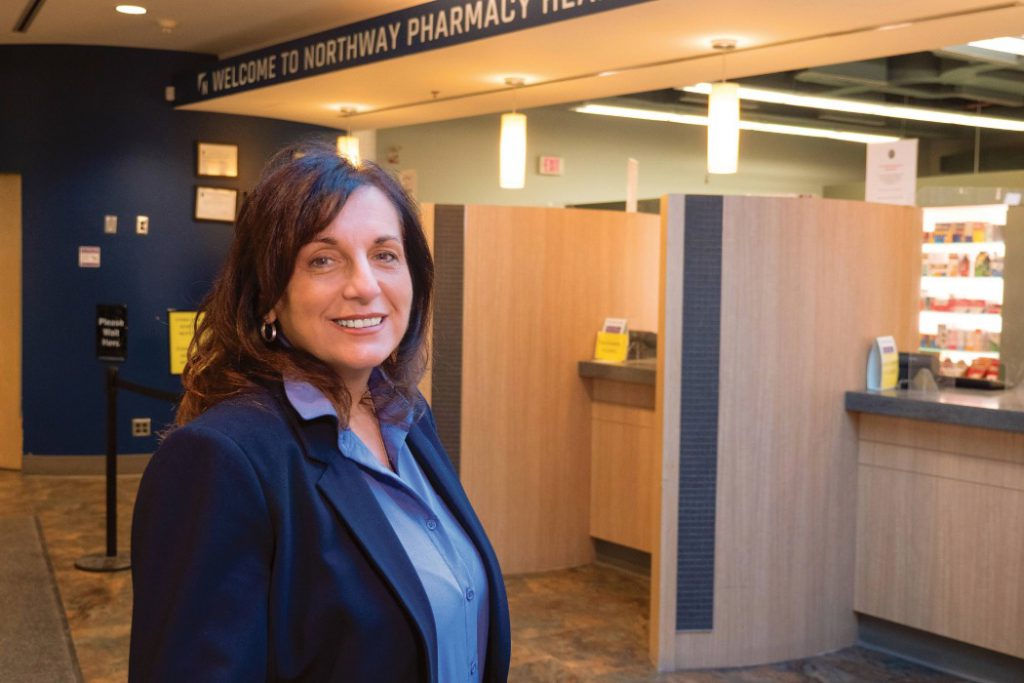
Gayle Romanetz [B.Sc.Pharm/84] was not sure which career path to take when she started her undergrad science studies at UM. A family member warned her that pharmacy would be too demanding. That only strengthened her resolve.
Romanetz, who comes from the small town of Ethelbert, Man., did pursue pharmacy and discovered a profession that integrates science with direct patient care.
“As it turned out, it was quite a wonderful choice,” she says.
Today, the 1984 UM alum lives in Winnipeg and is vice-president of operations at Northway Pharmacy, overseeing 16 locations, 14 of them in Manitoba. Her responsibilities range from patient care to regulatory compliance and long-term business sustainability.
“I place great value on being connected to our teams and the communities they serve,” she says. “Some days my work is centred on supporting frontline staff and operational decision-making; other days, it shifts to system-level advocacy and strategy.”
Romanetz views advocacy as central to her work. As the current board president of Pharmacists Manitoba, she is committed to shaping the future of pharmacy practice.
“I’m motivated to expand pharmacists’ role in delivering care,” she says. “I have seen the meaningful contributions pharmacists can make in harm reduction and in addressing health inequities.”
In 2021, when Romanetz was working for Loblaw as senior director of pharmacy operations for Western Canada, a large family medical clinic closed in Lethbridge, Alta. The resulting shortage of primary care strained emergency services.
In response, Romanetz played a key role in establishing Canada’s first pharmacist-led walk-in clinic, opened by Loblaw in Lethbridge in 2022.
“These clinics are geared to people who don’t have a regular primary-care provider,” she says. “For example, someone with diabetes and hypertension can see a pharmacist, get lab work and testing done, and receive a prescription they can fill at any pharmacy.”
The governments of other provinces, including Nova Scotia, New Brunswick and Ontario, have followed Alberta in allowing pharmacist-led clinics, although pharmacists’ scope of practice and prescribing authority in those provinces are not as broad as in Alberta.
Romanetz says these walk-in clinics improve access to care and ease pressure on urgent-care centres. She and Pharmacists Manitoba are advocating for an expanded scope of practice, and for pharmacist-led clinics to be introduced in the province.
One development she strongly supports is provincial legislation, expected in 2026, that will allow pharmacists to assess and prescribe hormonal contraception.
“If you need help with birth control, timely access is critical,” she says. “With about 1,100 pharmacists in more than 90 communities across Manitoba, women will be able to get a prescription and have it filled quickly.”
Romanetz encourages pharmacists and students to advocate for the profession. “Our voices as pharmacists matter,” she says.
In 2025, the Canadian Foundation for Pharmacy presented Romanetz with its Pillar of Pharmacy Award, recognizing her as “a trusted leader, skilled strategist and dedicated advocate for the evolving role of Canadian pharmacists.” She is the first pharmacist from Manitoba to receive this national honour.
Her proudest achievement, however, is personal: seeing her daughter, Christine Vaccaro [B.Sc./18, PharmD/23], graduate from UM as a member of the first class to earn the doctor of pharmacy (PharmD) degree.
BY DANICA HIDALGO CHEREWYK