
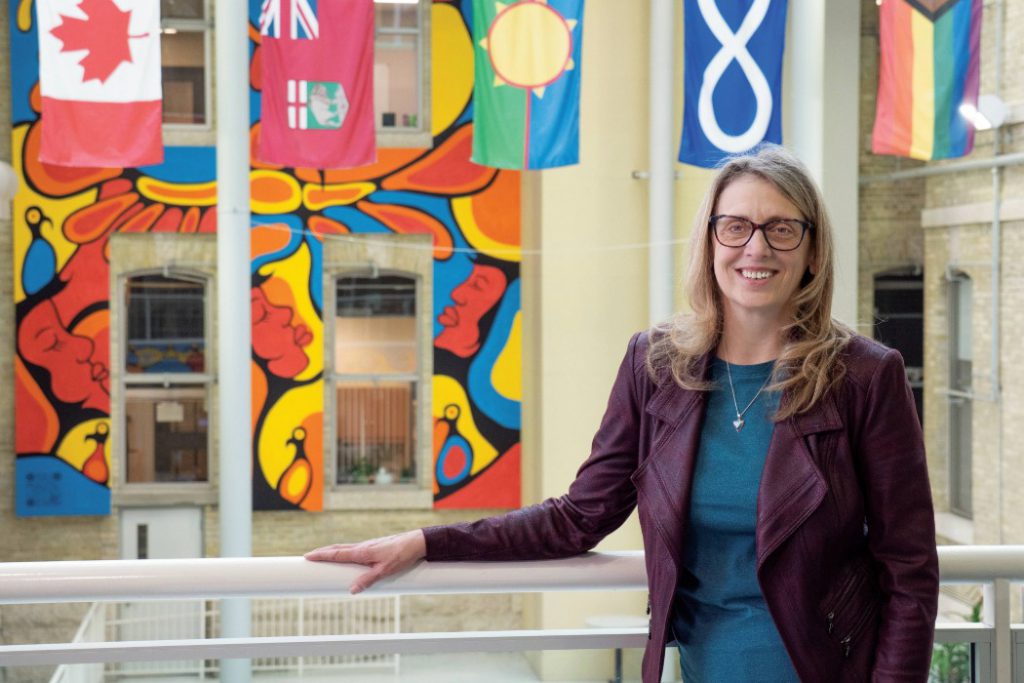
Fresh out of UM nursing school in 1984, Sharon Bruce [BN/84, MA/93, PhD/99] started working at the Winnipeg Children’s Hospital.
It didn’t take long for her to recognize that some children and families faced more obstacles to good health than others.
“I saw clear disparities,” she remembers. “Certain injuries and illnesses were over-represented, and many patients affected were Indigenous.
“After three years, I wanted to learn more about equity and disparities in health care.”
Bruce, who had grown up in Winnipeg, returned to UM. She earned a master’s in anthropology in 1993 and a PhD in medical anthropology in 1999, all while working part time as a nurse.
“I was drawn to anthropology because it considers people within broad social, historical and political contexts,” she says. “One reason I pursued my graduate education at UM was because the department of community health sciences had a strong program in Indigenous health.
“My family on my father’s side is Métis. The experience of colonialism is personal for us, but I wanted to gain a more critical, large-scale understanding.”
Today, Bruce is a professor in the College of Community and Global Health, where her teaching areas include culture and health and health promotion. She led the department of community health sciences from 2018 to 2023.
As a researcher, she focuses on Type 2 diabetes and works to improve health systems.
One UM mentor who strongly influenced her was Dr. Kue Young, one of the first researchers in Canada to recognize the emerging epidemic of Type 2 diabetes among First Nations. Through Young, Bruce was introduced to Sandy Bay Ojibway First Nation, a community she has partnered with since 2002.
“Respecting community sovereignty is essential in Indigenous-led research,” she says. “For too long, communities haven’t had decision-making power over what happens to them. Our work at UM must change that.”
Bruce and her team have worked with Sandy Bay to design research studies and improve health services, addressing needs ranging from maternal and child health to chronic disease management.
One research project confirmed that Sandy Bay has some of the highest rates of diabetes-related amputation in Canada among First Nations and young people.
The findings helped the community to secure funding for diabetic foot-care nurses and develop its own foot-care program.
“The community had a vision, and we were there to support them,” Bruce says.
There’s a pervasive stereotype, she says, that Indigenous people don’t care about their health. She has never forgotten hearing two young men who had participated in a study discuss their blood-work results. They had returned to the Sandy Bay health centre to ask for guidance.
“One was talking about his triglycerides. The other said, ‘My LDL is high.’ They were actively interested and concerned. It just struck me how completely wrong those stereotypes are.”
Bruce says she is always trying to impress upon learners that health equity depends on an economic, political and social framework.
“I tell my students it can be hard to see how health policy influences people’s lives,” she says.
“In many Indigenous communities, it hits you in the face – policy decisions shape services, and those decisions directly affect people.”
BY DANICA HIDALGO CHEREWYK